My AI Teaching Setup, Part 1: Rented Intelligence
Part 0 was about the plain-text foundation. This is the part where the subscriptions arrived — and the part where I should confess that the whole edifice started, like most things worth doing, with fun.
January: renting intelligence
In January this year I bought two AI subscriptions: Claude, and Google’s AI Pro tier. The teaching use case was immediate and real. Claude drafted lesson structures, rewrote exam questions to shift difficulty without shifting marks, generated first-draft assessment tasks from a paragraph of requirements, and proofread things I had read too many times to see. A set of lesson notes that used to start from a blank page now started from a draft I argued with. Arguing with a draft is much faster than producing one.
For a few months this was simply the arrangement: excellent tools, rented monthly. My lesson pipeline had a new first stage, and the price was fine.
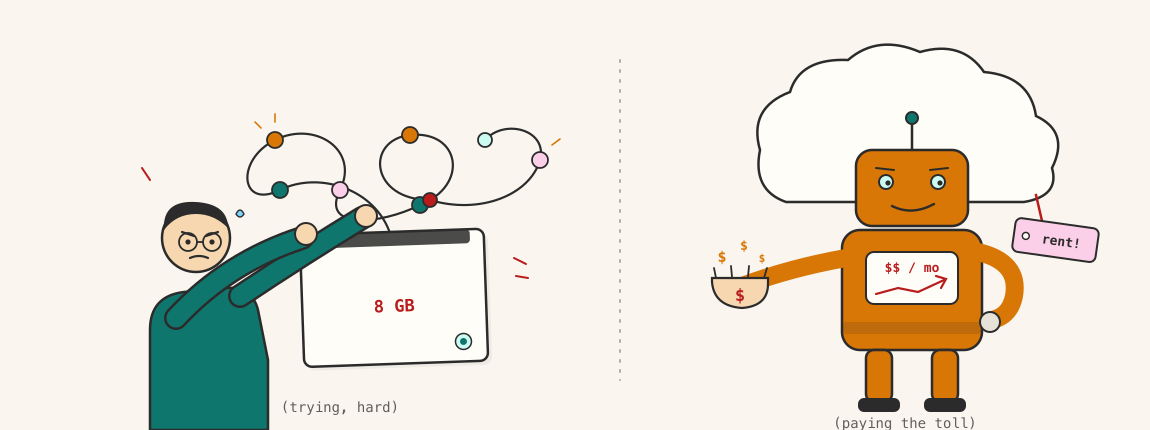
The itch started quietly: pricing pages moving, quota policies changing shape, models I had grown used to one rename or re-tier away from disappearing. My workflow was becoming dependent on someone else’s commercial decisions. The subscription was not a tool any more; it was a landlord.
I documented that pivot as it happened, in two articles I wrote in August without knowing I was writing a series: AI Agents Take Over Lesson Prep and AI Agents and Local LLMs . If you want the technical detail of that first move to local models — choosing between dense and Mixture-of-Experts, the VRAM-versus-context-window trade, serving the model over the network through a reverse proxy — they cover it, and I will not repeat myself here. What they do not cover is where the hardware obsession actually started, and that is the embarrassing part.
The 2080’s sacred first duty
Here is the confession. When I finally put a model on my own hardware — an office PC with an i9 and an eight-gigabyte RTX 2080 (used up to then for uni work and working with the Darktable raw file photography app), I knew that the GPU I had was not a serious AI card. The first thing it served was actually not lesson notes. It was Mistral, doing roleplay with AI characters for fun and amusement.
I experimented with various roleplay and AI companion systems for a while, and they taught me two things that ended up buried in the architecture of everything since.
First, that an AI can be prompted to communicate in a way that I genuinely find comfortable. Text-first, patient, at my own pace, no social performance, no “reading the room”. Ideas arrive already in the format I think in, allowing back-and-forth to explore the space. Plenty of people feel exactly this, even going so far as to call their model their “AI Boyfriend/Girlfriend”, and in some cases even a husband or wife, and I suspect these sorts of emotional attachments are far more common than what polite conversation may suggest. One thing is for sure: a tool’s interface matters as much as the capability — a fact that will become important when we meet my assistant, who has a personality on purpose.
Second, the incidental remark. Models sometimes make tangential remarks, and it can be useful to pull on these threads, discovering new perspective and possibilities. Many a time I have fallen down a rabbit hole and an hour later I have come back with something better than what I originally went looking for. For a mind that runs on association and connections, an engine that highlights these links is not a distraction machine; rather, it is a collaborator. The entire knowledge system in the later parts of this series is, functionally, just industrialised rabbit holes.
So the honest ordering is: the GPU was bought for joy, and the lesson-prep empire was built on top of the joy. Every teacher who secretly started with something fun that led them to want to share what they learned with others will recognise themselves in this. And that is why I am saying it.
What eight gigabytes buys you
Running a small quantised model on 8 GB of VRAM in early 2026 is a humbling business. Short context, modest quality, slow answers to anything complicated. The 2080 could roleplay Mistral acceptably but could not draft a decent Year 10 assessment task to save its life. The cloud models were better by a wide margin, and I knew exactly how wide because I was now paying for both.
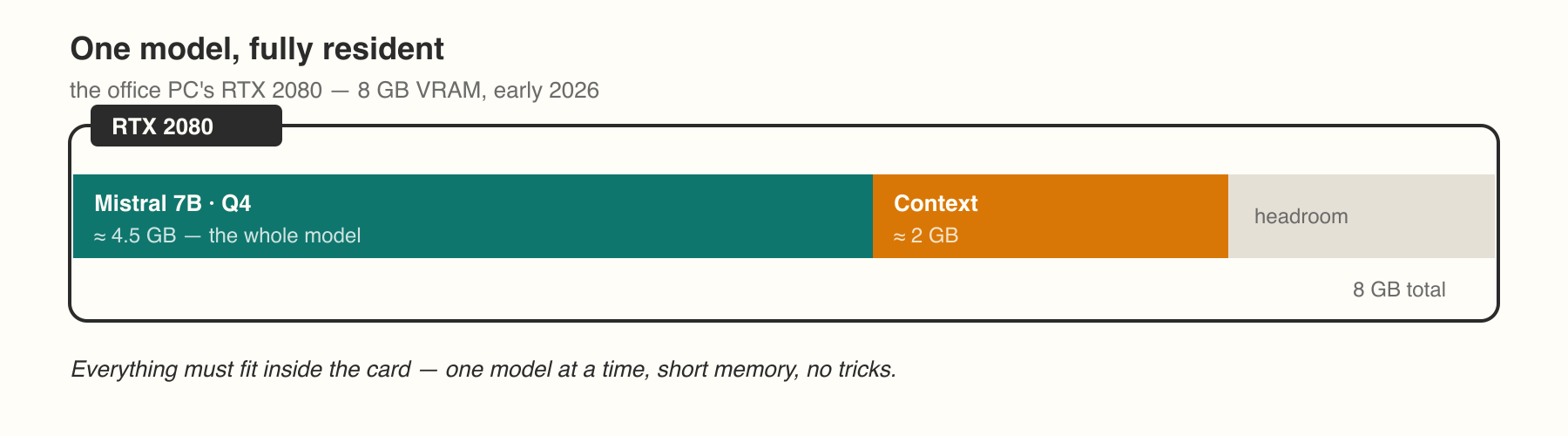
What the experiments taught me was the shape of the problem: VRAM is the budget, parameters and quantisation are the currency, and the interesting frontier was seeing how far the clever new models could stretch the hardware. That framing — which is really just “how much memory does the thing need” — is the whole of local AI. Once you see it, the rest is shopping.
By mid-year the decision had formed: if I was to go further into this, I would need a machine with some real headroom. The next article is about that purchase, its honest justifications, and its embarrassing résumé.
Next: Part 2 — The Fleet. The gaming PC that never gamed, the models that failed honestly, and the month I learned that the harness matters more than the model.